Federal Court Grants New Trial in Federal Criminal Case Following Rule 33 Motion
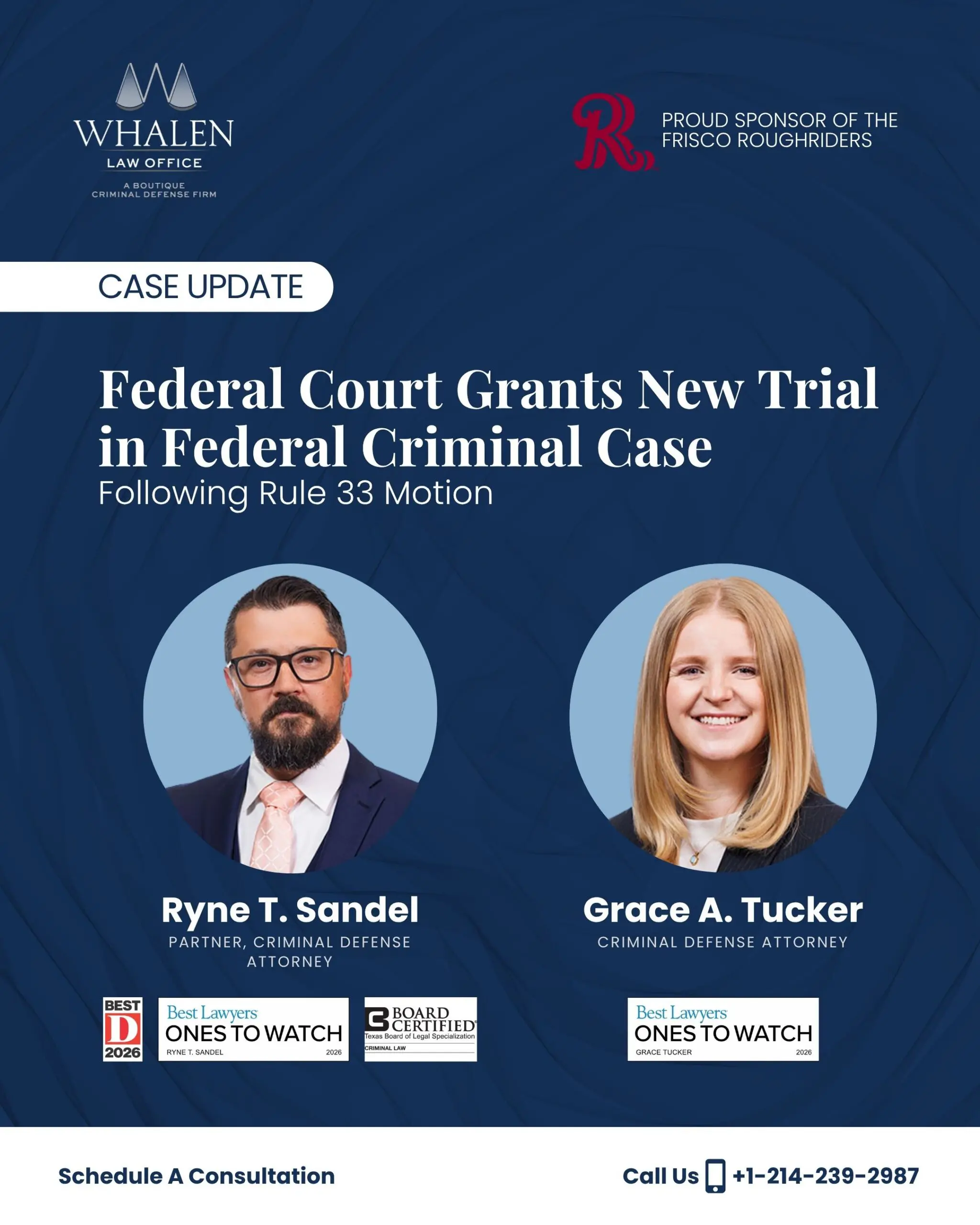
Whalen Law Office attorneys Ryne Sandel and Grace Tucker recently obtained a new trial for a client in a federal criminal case in the Northern District of Texas.
On September 18, 2026, U.S. District Judge Karen Gren Scholer issued a 17-page Memorandum Opinion and Order addressing the client’s post-trial motions following a seven-day jury trial earlier this year. The jury had returned guilty verdicts on all counts, including charges involving conspiracy to defraud the United States and health care kickbacks, offer and payment of kickbacks and bribes in connection with a federal health care program, and monetary transactions involving criminally derived property.
Following the verdict, Sandel and Tucker continued to litigate the case through post-trial motions under Rules 29 and 33 of the Federal Rules of Criminal Procedure.
The Court denied the defense motions for acquittal under Rule 29 but granted the Motion for New Trial under Rule 33 on all counts. The Court ordered that the case be set for trial again.
Court Finds Verdict Could Not Stand
In granting the new trial, the Court explained that Rule 33 permits a trial court to weigh the evidence and assess witness credibility when determining whether the interests of justice require a new trial.
After reviewing the complete trial record, the Court concluded that the evidence “preponderates heavily against the verdict” and that allowing the verdict to stand would be a “miscarriage of justice.”
Judge Scholer also noted in a footnote that, in more than 16 years on the state and federal bench, this was the first time she had granted a new trial.
The Court’s ruling was based in significant part on its assessment of the evidence concerning the Anti-Kickback Statute charges. The Court found that the evidence weighed heavily against the conclusion that the client intended to improperly influence the healthcare decisionmakers.
The Court identified the patients’ physicians as the relevant healthcare decisionmakers and noted that physicians retained the ability to independently review and reject testing requests. The trial evidence showed that approximately 80% to 90% of the order forms were not signed by physicians.
The Court also considered evidence concerning the structure of the order forms, laboratory compliance procedures, and testimony presented during the trial.
After weighing the evidence and assessing witness credibility, the Court determined that the evidence supporting the government’s theory did not outweigh the evidence presented by the defense on the issue of improper influence.
The same reasoning supported the Court’s decision to order a new trial on the conspiracy count. Because the monetary-transaction counts were based on the alleged underlying unlawful conduct, the Court also determined that a new trial was warranted on those counts.
Ryne Sandel and Grace Tucker’s Role in the Defense
Ryne Sandel and Grace Tucker worked together throughout the case as members of the defense team, including during the seven-day trial and the post-trial proceedings.
During the trial, Sandel challenged the government’s evidence through cross-examination of government physicians concerning the role of physicians in deciding whether cardiovascular genetic testing should be ordered. Those examinations addressed whether physicians maintained independent decision-making authority over the testing requests.
Following the jury’s verdict, Sandel and Tucker continued to develop and present the defense’s post-trial arguments under Rules 29 and 33.
Tucker played a substantial role in the post-trial litigation, including preparing the defense’s briefing and presenting argument before the Court on the motion for a new trial. Sandel also handled significant aspects of the post-trial proceedings and continued advocating for the defense’s position that the verdict should not stand.
The Court ultimately granted the Rule 33 motion and directed that the case proceed to a new trial.
An Important Issue Under the Anti-Kickback Statute
The case involved questions concerning the application of the federal Anti-Kickback Statute to a business arrangement involving marketing and cardiovascular genetic testing.
The defense maintained that a compensation arrangement tied to marketing volume was not, by itself, sufficient to establish a criminal kickback. The key issue was whether the compensation was intended to improperly influence the individuals actually making healthcare decisions.
In its ruling, the Court emphasized the physicians’ role as decisionmakers and concluded that the weight of the evidence did not support the government’s theory of improper influence.
The ruling provides an example of the role post-trial review can play in a federal criminal case. A jury verdict is a significant stage in a prosecution, but federal rules also provide mechanisms for a trial court to review the evidence and determine whether a verdict should stand.
What Happens Next?
The Court’s September 18 order granted a new trial rather than an acquittal. The case will proceed toward a new trial, which the Court stated will be set by separate order.
Whalen Law Office continues to represent the client in the matter.
About Ryne Sandel
Ryne Sandel is a Partner at Whalen Law Office whose practice includes federal criminal defense, including complex federal investigations and litigation. He represents clients facing serious federal criminal allegations and handles matters involving trial, post-trial litigation, and appeals.
About Grace Tucker
Grace A. Tucker is an Associate Attorney at Whalen Law Office whose practice includes criminal defense and juvenile criminal defense. She has experience in federal criminal defense and post-trial litigation and is admitted to practice in federal courts across Texas and the Fifth Circuit Court of Appeals.
Past results do not guarantee future outcomes. Nothing on this website constitutes legal advice.