Federal vs. State Fraud Charges in Texas: What You Need to Know

When fraud charges are filed in Texas, one of the first and most consequential questions is whether the case will be prosecuted in state or federal court. The answer matters enormously — for the resources brought to bear against you, the procedural rules that govern the case, the penalties you face, and the type of defense strategy required.
Many people assume that fraud is fraud, and that the courthouse where charges are filed is a technicality. In reality, federal and state fraud prosecutions are fundamentally different proceedings, and the distinction between them shapes every aspect of how a case develops from investigation through sentencing.
Below, we explain how jurisdiction is determined in Texas fraud cases, the key differences between federal and state prosecution, how penalties compare between the two systems, and what it means for your defense when jurisdiction shifts or overlaps.
How Jurisdiction Is Determined in Texas Fraud Cases
The decision to prosecute a fraud case in federal versus state court depends on whether the alleged conduct implicates federal interests. Federal jurisdiction typically attaches when one or more of the following factors are present:
- The use of wire communications, electronic transmissions, or the U.S. mail in furtherance of the scheme — triggering federal wire fraud (18 U.S.C. § 1343) or mail fraud (18 U.S.C. § 1341) statutes
- Involvement of a federally insured or regulated financial institution, such as a bank, credit union, or mortgage lender
- The fraud involved a federal program, benefit, or agency — including Medicare, Medicaid, SBA loan programs, or federal contracts
- The conduct crossed state lines, implicating interstate commerce
- Securities, commodities, or investment instruments subject to federal regulatory oversight were involved
- The scale or complexity of the scheme warrants the greater resources of a federal investigation
When conduct is confined entirely within Texas — involving only Texas parties, no federal programs, no federally regulated institutions, and no interstate communications — state prosecution under the Texas Penal Code is more likely. But in practice, the reach of federal jurisdiction is broad. The use of a smartphone, email, or bank account is often sufficient to establish federal wire fraud jurisdiction, even in what appears to be a local matter.
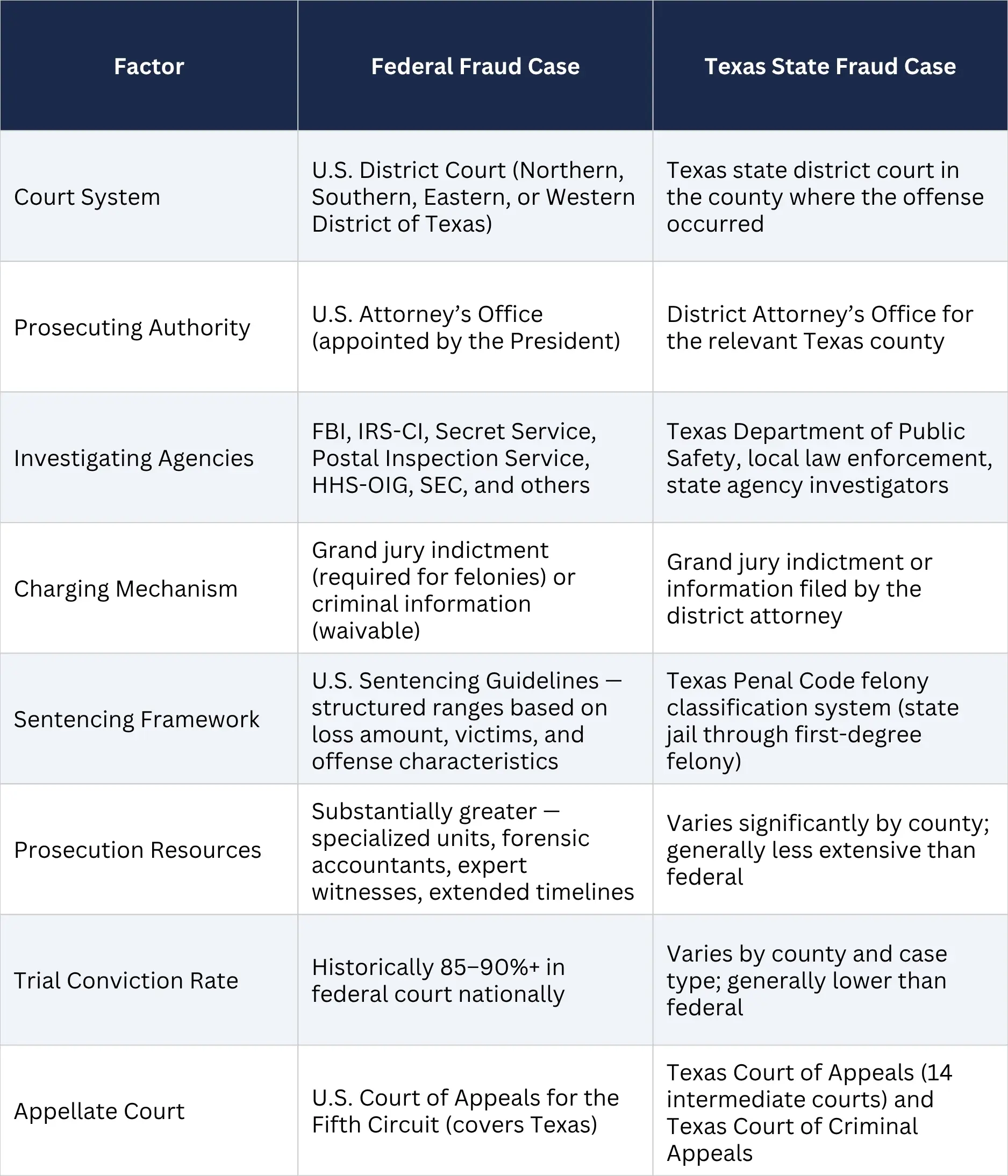
Federal vs. State Fraud Prosecution: A Side-by-Side Comparison
The table below summarizes the most important practical differences between federal and state fraud cases in Texas:
Federal Fraud Penalties in Texas
Federal fraud charges carry some of the most significant penalties in the criminal justice system. The most frequently charged federal fraud statutes and their maximum penalties include:
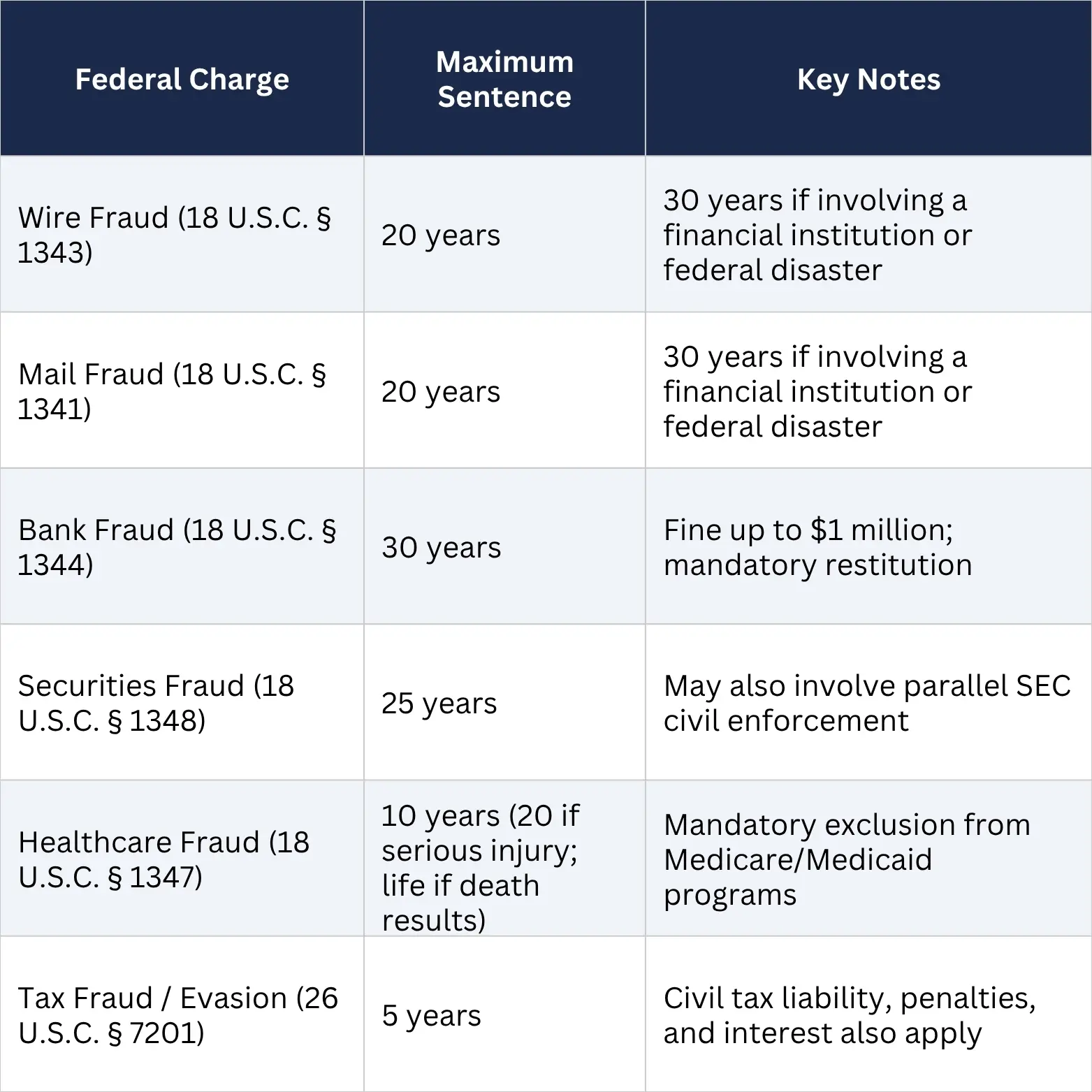
Beyond statutory maximums, actual sentences in federal fraud cases are governed by the U.S. Sentencing Guidelines. The loss amount is the single most significant driver of the Guidelines calculation — and it can result in substantial recommended ranges even in first-offense cases. Contesting the government’s loss calculation is often one of the most impactful aspects of federal fraud defense.
Texas State Fraud Penalties
Under Texas law, fraud and theft offenses are classified primarily by the value of the loss, with enhanced penalties for certain offense types. The general classification framework under the Texas Penal Code is:
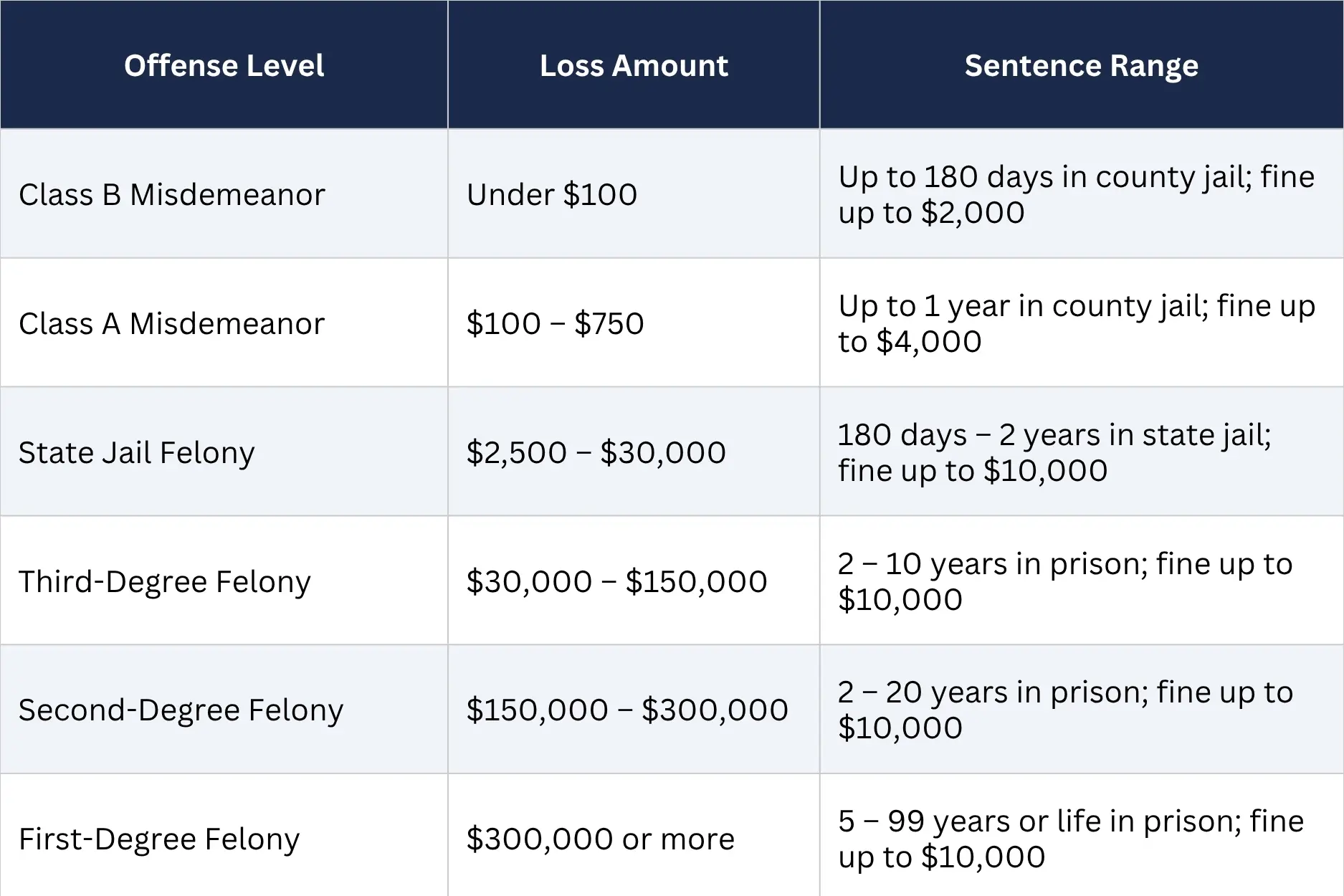
Certain Texas fraud offenses carry enhanced penalties beyond the standard loss-based classification, including organized criminal activity (which can elevate the charge by one level), securities fraud under the Texas Securities Act, insurance fraud, and identity theft involving multiple victims.
Can You Face Both Federal and State Fraud Charges?
Yes. The Double Jeopardy Clause of the Fifth Amendment prohibits being prosecuted twice by the same sovereign for the same offense. However, the state and federal governments are considered separate sovereigns — meaning the same underlying conduct can be prosecuted separately by both, without violating Double Jeopardy protections.
In practice, dual prosecution is most common in cases involving identity theft, mortgage fraud, and large-scale financial schemes that implicate both state criminal statutes and federal law. When federal prosecutors take the lead, state charges are frequently deferred or dropped as part of a plea resolution — but this is not guaranteed. Retaining defense counsel experienced in both systems provides the most comprehensive protection when dual jurisdiction is a realistic possibility.
When a State Fraud Case Becomes a Federal Case
Jurisdiction in a fraud case is not always fixed from the outset. A state investigation can attract federal attention — or be formally referred to federal authorities — when:
- The state investigation uncovers evidence of interstate wire communications or use of the mail, creating federal jurisdiction
- The alleged loss amount grows as the investigation expands, making the case more attractive to federal prosecutors
- Evidence of involvement by a federally regulated institution or federal program emerges
- A cooperating witness or co-defendant provides information that draws in federal agencies
- The scheme’s complexity or multi-jurisdictional nature warrants the greater resources of federal prosecution
When this transition occurs, everything changes: the prosecuting authority, the court, the procedural rules, the sentencing framework, and the resources arrayed against the defendant. Individuals who are managing a state fraud matter without the benefit of federal criminal defense experience are often poorly positioned when this shift happens. Engaging counsel with experience in both systems from the outset is the most effective way to prepare for this possibility.
Whalen Law Office: Federal and State Fraud Defense Across Texas
Whether your fraud case is in state or federal court — or both — the quality of your legal representation is the most important variable in the outcome. Whalen Law Office represents individuals and businesses facing fraud charges in both state and federal courts across Texas and nationwide.
The firm’s attorneys are admitted to all four Texas federal districts — the Northern, Southern, Eastern, and Western Districts — as well as the Fifth Circuit Court of Appeals. The firm’s offices in Frisco, Sherman, and Tyler provide direct access to both the Northern District (Dallas) and the Eastern District (Sherman and Tyler), the two federal courts most active in Texas fraud enforcement. James Whalen is board-certified in both criminal law and criminal appellate law by the Texas Board of Legal Specialization, and the firm brings nearly three decades of experience to the defense of complex state and federal criminal matters.
Frequently Asked Questions: Federal vs. State Fraud Charges in Texas
What determines whether a fraud case is prosecuted at the federal or state level in Texas?
The primary factors that determine federal versus state jurisdiction in a fraud case are the nature of the conduct and whether it implicates federal interests. Federal jurisdiction typically attaches when the alleged fraud involves: the use of wire communications or the mail (triggering federal wire fraud or mail fraud statutes); a federally regulated financial institution such as a bank or credit union; a federal program, benefit, or agency; interstate commerce — meaning the conduct crossed state lines in some meaningful way; or securities, commodities, or other instruments subject to federal regulatory oversight. When conduct is entirely intrastate — occurring within Texas, involving only Texas entities, and not touching any federal program or institution — state prosecution is more likely. In practice, however, the line between state and federal jurisdiction is not always clear, and many fraud cases are pursued at the federal level even when the underlying conduct appears primarily local.
What are the most significant practical differences between federal and state fraud cases?
The differences between federal and state fraud prosecutions in Texas are substantial and affect every aspect of the case from investigation through sentencing. Federal cases are investigated by agencies with significantly greater resources — including the FBI, IRS-CI, and specialized federal task forces — and the investigation is typically more extensive and longer-running before charges are filed. Federal prosecutions proceed under the Federal Rules of Criminal Procedure and are governed by the U.S. Sentencing Guidelines at sentencing, which produce structured sentence ranges based on loss amounts, number of victims, and other factors. Federal conviction rates are consistently high — historically above 85-90 percent of cases that go to trial. State fraud cases in Texas are prosecuted under the Texas Penal Code, tried in state district courts, and sentenced under the Texas felony classification system. Both are serious, but the federal system generally involves greater prosecutorial resources and more structured sentencing consequences.
What are the penalties for federal fraud charges in Texas?
Federal fraud penalties depend on the specific charges, the loss amount, and aggravating factors under the U.S. Sentencing Guidelines. Wire fraud and mail fraud each carry maximum sentences of up to 20 years in federal prison per count; bank fraud carries up to 30 years. These maximums are rarely imposed, but the Sentencing Guidelines can produce significant recommended ranges even in cases involving relatively modest loss amounts. For example, a fraud involving a loss of $250,000 to $550,000 adds 12 offense levels to the base calculation, which can translate to several years in federal prison for a defendant with no prior record. In addition to incarceration, federal fraud convictions typically result in supervised release, substantial fines, and mandatory restitution to victims. Asset forfeiture may also apply.
What are the penalties for state fraud charges in Texas?
In Texas, fraud offenses are classified under the Texas Penal Code according to the value of the alleged loss or the nature of the conduct. Theft and fraud offenses below $2,500 may be misdemeanors. Offenses involving amounts between $2,500 and $30,000 are state jail felonies, carrying sentences of 180 days to 2 years in a state jail facility. Third-degree felonies (losses of $30,000 to $150,000) carry 2 to 10 years in prison; second-degree felonies ($150,000 to $300,000) carry 2 to 20 years; and first-degree felonies (losses over $300,000) carry 5 to 99 years or life. Fines of up to $10,000 may apply to any felony level, along with restitution. Certain fraud offenses — such as organized criminal activity, securities fraud, or healthcare fraud — carry enhanced penalties under specific Texas statutes.
Can I face both state and federal fraud charges for the same conduct?
Yes. The Double Jeopardy Clause of the U.S. Constitution prohibits being prosecuted twice for the same offense by the same sovereign, but it does not prevent separate state and federal prosecutions arising from the same underlying conduct — because the state and federal governments are considered separate sovereigns. In practice, when conduct is serious enough to warrant federal prosecution, federal prosecutors typically take the lead and state charges may be deferred or dropped. However, parallel or sequential state and federal prosecutions do occur, particularly in cases involving identity theft, mortgage fraud, or large-scale financial schemes that implicate both Texas state statutes and federal law. Having counsel with experience in both federal and Texas state court is essential when dual jurisdiction is a possibility.
Can a state fraud investigation become a federal case?
Yes — and this transition can happen faster than most people expect. A state fraud investigation that uncovers evidence of interstate wire communications, involvement of federally insured financial institutions, or connections to federal programs may be referred to federal authorities or attract parallel federal attention. Conversely, information developed during a federal investigation may be shared with state prosecutors. The transition from state to federal jeopardy often occurs without advance notice to the defendant, and the stakes change dramatically when it does. This is one of the most important reasons to engage defense counsel with experience in both systems at the earliest stage of any fraud investigation.
What federal agencies are most commonly involved in fraud investigations in Texas?
The federal agencies most frequently involved in Texas fraud investigations include: the Federal Bureau of Investigation (FBI), which has field offices in Dallas and other Texas cities and investigates a wide range of financial fraud, corporate fraud, and public corruption; the IRS Criminal Investigation Division (IRS-CI), which focuses on tax fraud, money laundering, and financial crimes; the U.S. Postal Inspection Service, which investigates mail fraud and schemes involving the U.S. mail; the Securities and Exchange Commission (SEC), which investigates securities fraud and investor protection violations; the Department of Health and Human Services Office of Inspector General (HHS-OIG), which investigates healthcare fraud; and the SBA Office of Inspector General, which has been particularly active in COVID-relief fraud cases. Many cases involve multiple agencies working in coordination under a joint task force structure.
How does the U.S. Sentencing Guidelines system work in federal fraud cases?
The U.S. Sentencing Guidelines are a structured framework that federal judges use to calculate a recommended sentencing range in criminal cases. In fraud cases, the calculation starts with a base offense level and then applies adjustments based on factors including the total loss amount (which adds significant levels as losses increase), the number of victims, whether the offense involved sophisticated means, whether the defendant was an organizer or leader, and whether the defendant accepted responsibility. The resulting offense level is combined with the defendant’s criminal history category to produce a recommended sentence range in months. While judges have discretion to depart from this range, sentences within the Guidelines are common. Understanding and contesting the Guidelines calculation — particularly the loss amount, which is often disputed — is one of the most important aspects of federal fraud defense.
Why does it matter that Whalen Law Office is admitted in all four Texas federal districts?
Texas has four federal judicial districts — the Northern, Southern, Eastern, and Western Districts — each with its own courthouse locations, local rules, judicial personalities, and procedural culture. Federal fraud cases are filed in the district where the alleged conduct occurred or where the defendant resides. Having defense counsel who is admitted to and regularly practices in the relevant district provides a significant practical advantage: familiarity with the local federal prosecutors, knowledge of the judges’ preferences and tendencies, and experience with the specific procedural norms of that court. Whalen Law Office’s attorneys are admitted to all four Texas federal districts, as well as the Fifth Circuit Court of Appeals, providing comprehensive coverage for clients facing federal fraud charges anywhere in Texas.
Speak With a Fraud Defense Attorney in Texas
Whether you are facing state or federal fraud charges in Texas — or are at the investigation stage and not yet sure which direction the case will go — experienced legal representation from the outset is the most important decision you can make. The differences between the two systems are substantial, and your defense strategy must account for both.
Whalen Law Office represents clients facing fraud charges in Frisco, Sherman, Tyler, and across Texas and the United States. Contact our office to schedule a confidential consultation and understand your legal options.